SYNOPSIS
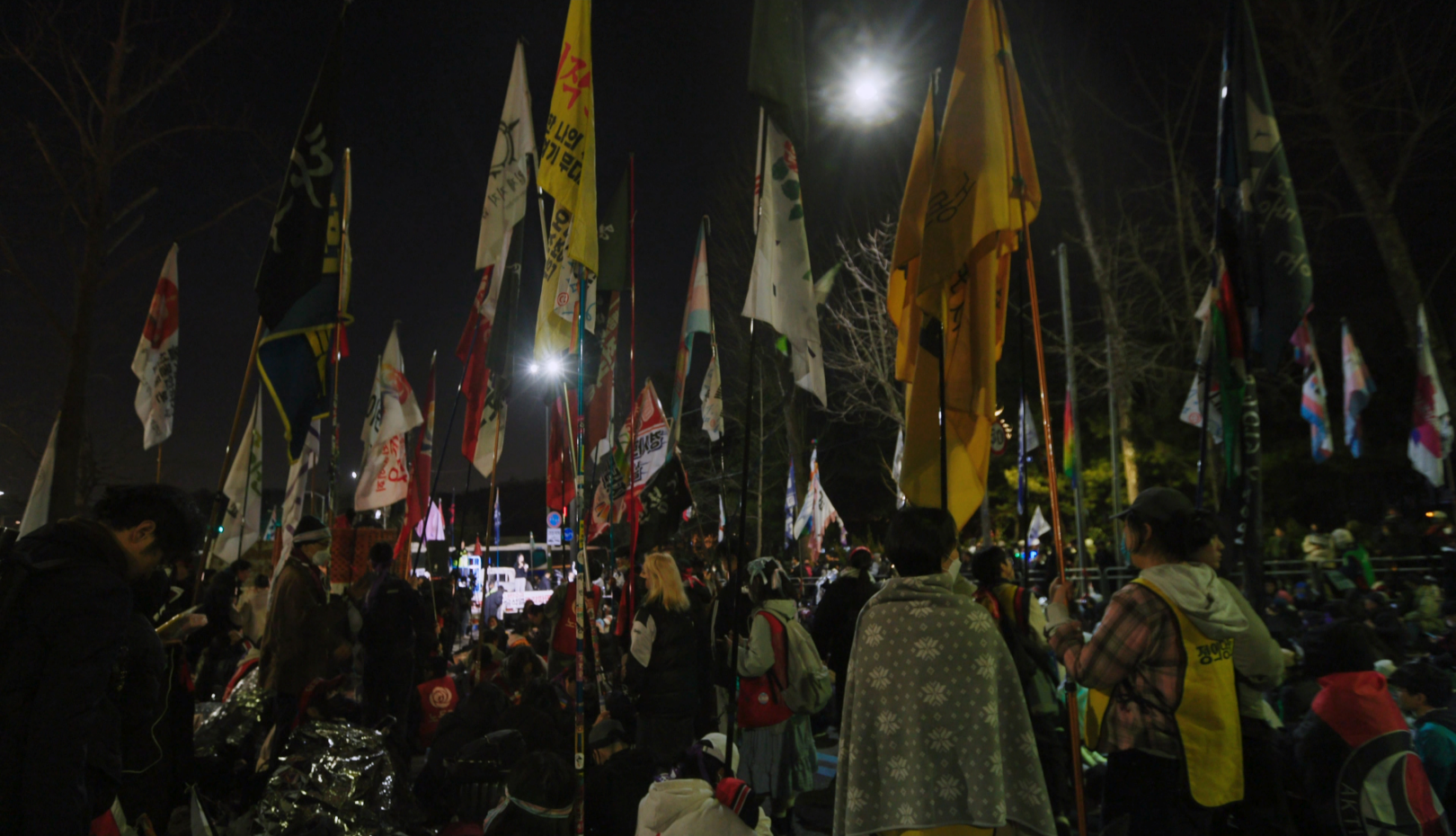
The third year of the Yoon Suk-yeol administration. The nation was already at a boiling point. A single move by the president to end democracy backfired, opening up the square. This is a record of an accidental square that emerged in Namtaeryeong on a winter solstice night. It is a testimony to the changes brought about by that one night in the square, and a chronicle of people's struggles to carry the spirit of Namtaeryeong into their daily lives.
REVIEW
As an alternative medium, independent documentary inevitably remains close to sites of failure. Yet some films have shown us that even within losing struggles, the precious seed of community can begin to grow—even if, years later, that seed survives only as a faded memory marked by reflection and regret. The Longest Night: Namtaeryeong courageously approaches the Namtaeryeong struggle as an ongoing record of victory, despite the uncertainty of what lies ahead.
The film focuses on social media as the medium through which a community came into being, interviewing figures who seem almost to embody the human face of the platform itself. What moved people was not a finished wall poster but urgent fragments of language flying through Twitter. Your words joined mine; scattered pieces connected and became whole. Perhaps this generative power of language was the struggle that night. These fragments ultimately transformed the tractor into a new symbol. What phrase could better capture how people felt about it than “My dream is to become a tractor”? The tractor comes to signify every act of stepping into places we had never imagined entering: from the regions to Seoul, from Seoul back to the regions, and from one region to another; from my movement to yours, which I once believed had nothing to do with me. The Longest Night: Namtaeryeong reminds us of the courage to trust an unfamiliar hand reaching out and simply follow where it leads. (KIM Sohee)
DIRECTOR'S NOTE
Experiencing something intensely beautiful can completely change a person's life. Even in an identical daily routine, a slight shift in one's perspective on life and society can create a vast difference over time, ultimately changing the world. This 1° shift is the engine of history I discovered at Namtaeryeong. I wish to convey my gratitude and solidarity to the citizens who strive to revive democracy in their everyday lives as it becomes increasingly hollow and formalized.
CONTACT
Cinema DAL | HONG Lina | festival@cinemadal.com